•
ActiveCampaign vs. HubSpot: The Complete CRM Comparison for Growing Businesses
February 5, 2026
Quick Comparison Summary
ActiveCampaign wins for businesses that prioritize powerful email marketing automation and customer experience at competitive pricing. HubSpot wins for teams needing integrated sales and marketing operations with comprehensive all-in-one capabilities who are willing to invest in premium pricing for enterprise-level features.
Still unsure which platform fits your specific needs? Read our detailed comparison below or contact Capital S Consulting for expert guidance.
• Who each platform fits: ActiveCampaign serves businesses prioritizing email marketing automation and customer segmentation; HubSpot serves teams requiring integrated marketing, sales, and customer service operations
• Time-to-value insights: ActiveCampaign delivers immediate automation capabilities within days; HubSpot requires weeks for full implementation but offers comprehensive long-term scalability
• TCO considerations: ActiveCampaign provides predictable contact-based pricing starting at $29/month; HubSpot's ecosystem approach can reach $800+/month but consolidates multiple tool costs
When evaluating customer relationship management systems, businesses often find themselves comparing two fundamentally different approaches to marketing automation and customer experience. ActiveCampaign excels at sophisticated email marketing automation and customer segmentation workflows, making it ideal for businesses where email marketing drives revenue growth. HubSpot provides an integrated ecosystem spanning marketing automation, sales pipeline management, customer service, and content management, serving companies that need unified operations across multiple departments.
Both platforms address critical gaps in customer relationship management and lead generation, but their implementation complexity and cost structures differ significantly. ActiveCampaign focuses on automation depth and email marketing deliverability, while HubSpot emphasizes operational alignment and comprehensive reporting capabilities for sales and marketing teams.
From an implementation perspective, the choice between these platforms often determines your team's workflow approach for years. Companies choosing ActiveCampaign typically see faster initial results through automated email sequences and customer segmentation, with basic automation workflows operational within 2-3 days and advanced customer journeys deployed within 1-2 weeks. Organizations selecting HubSpot invest in long-term operational efficiency through unified data management and cross-functional collaboration, requiring 2-4 weeks for comprehensive setup but achieving better interdepartmental alignment within 4-6 weeks.
The decision deserves strategic consideration of your customer interactions, sales cycle optimization, and long-term business growth objectives. Rather than choosing based on feature comparisons alone, evaluate which platform aligns with your team's existing processes and scaling requirements. Contact Capital S Consulting for expert guidance tailored to your specific implementation needs.
We evaluated both platforms across four critical factors that determine successful CRM implementation:
Implementation Complexity
Speed to productivity, onboarding process timeline, and customer experience during initial setup. ActiveCampaign typically enables email automation within hours, while HubSpot requires more comprehensive setup but provides better long-term infrastructure.
Feature Value per Dollar
Capabilities per pricing tier, understanding true cost per user, and avoiding unnecessary feature bloat. We analyzed how pricing scales with contact growth and essential functionality access across plans.
Scalability and Customization
Growth adaptation, future-proofing capabilities, and integration ecosystem depth. Both platforms handle scaling differently - ActiveCampaign through automation sophistication, HubSpot through operational expansion.
Integration Ecosystem
Connection capabilities, no-code integrations, and knowledge management connectivity. We evaluated native integrations, API flexibility, and third-party marketplace options for extending platform functionality.
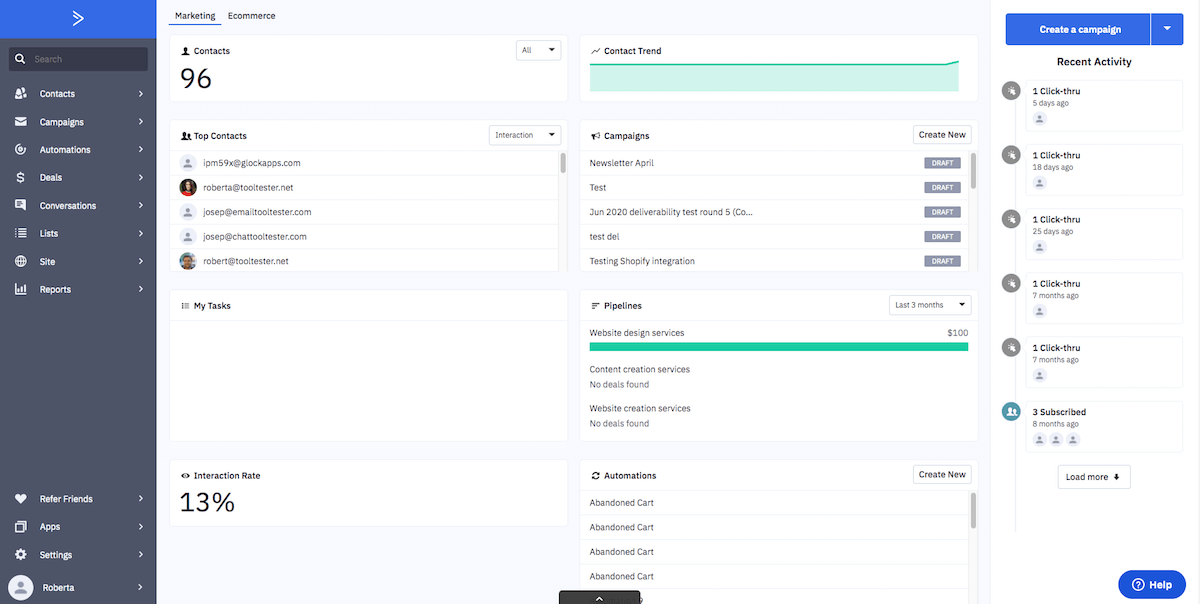
ActiveCampaign serves as a marketing-first platform that integrates CRM functionality with advanced automation capabilities. Unlike broad-spectrum business platforms, it prioritizes email marketing sophistication and behavioral customer journey mapping.
Quick Summary Box
Platform strength: Advanced email marketing automation with predictive analytics Integration reality: 1,000+ native integrations with extensive API access
Custom work indicator: Advanced automation workflows possible without development Cost insight: Contact-based pricing starting at $29/month with transparent scaling
Pricing Structure
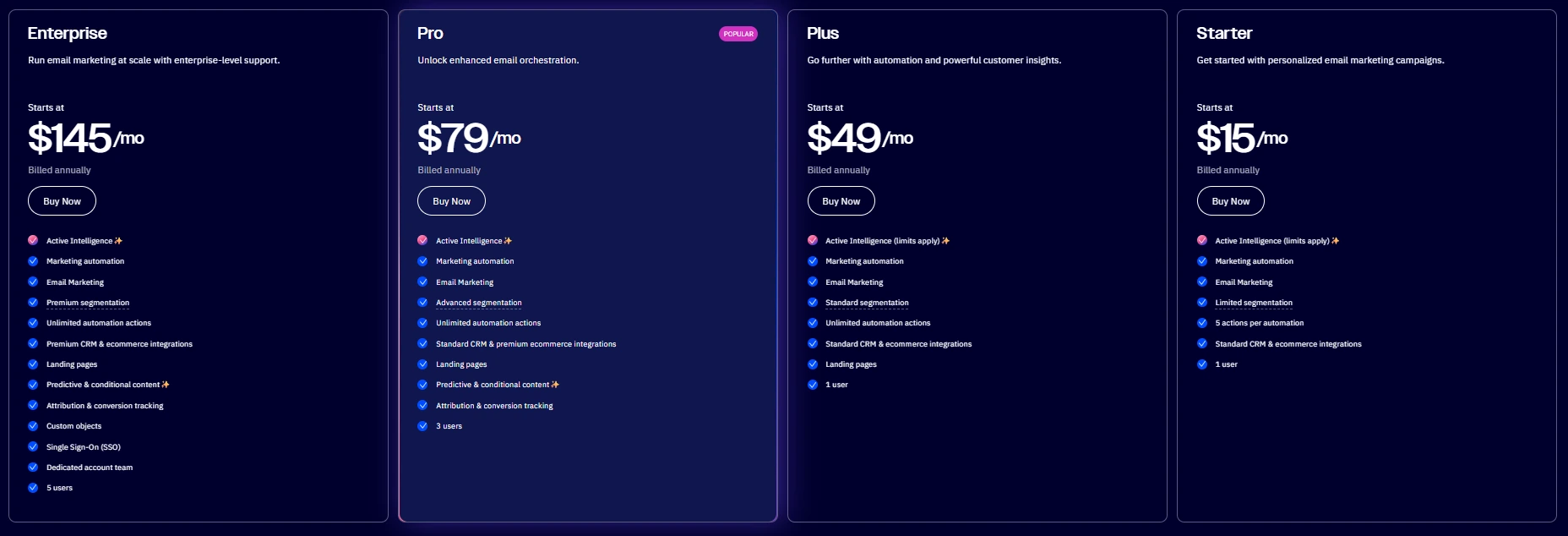
ActiveCampaign offers four main pricing tiers based on contact count with transparent scaling:
• Starter: $15/month for 1,000 contacts | $49/month for 2,500 contacts | $69/month for 5,000 contacts (annually)
• Plus: $49/month for 1,000 contacts | $70/month for 2,500 contacts | $99/month for 5,000 contacts (annually)
• Professional: $79/month for 1,000 contacts | $184/month for 2,500 contacts | $224/month for 5,000 contacts (annually)
• Enterprise: $149/month for 1,000 contacts | $334/month for 2,500 contacts | $379/month for 5,000 contacts (annually)
Pricing verified January 2026, subject to change. Annual billing includes significant discounts compared to monthly plans.
Key Features and Capabilities
Marketing Automation: ActiveCampaign's visual automation builder enables complex customer journeys with conditional logic, split testing, and behavioral triggers. Teams can create sophisticated email campaigns that respond to customer interactions across multiple touchpoints.
Customer Segmentation: Dynamic segmentation based on behavior, engagement, demographics, and custom fields allows precise targeting. The platform automatically updates contact segments as customer data changes, ensuring relevant communication.
Email Marketing: Advanced personalization, deliverability optimization, and A/B testing capabilities. Users report significantly higher open rates and click-through performance compared to other email marketing platforms.
Sales Pipeline Management: Built-in CRM functionality tracks deals, assigns tasks, and manages customer interactions. Sales automation features connect marketing activities directly to deal progression and revenue attribution.
AI-Powered Insights: Machine learning capabilities include predictive sending, win probability scoring, and content optimization suggestions. These features help optimize campaign performance without manual analysis.
Our Take
ActiveCampaign delivers immediate impact for marketing-driven organizations through automation workflows that typically show results within days rather than weeks. From a CRM implementation perspective, the platform's strength lies in transforming email performance - users frequently report dramatic improvements in open rates and customer engagement versus other platforms.
However, organizations requiring comprehensive sales operations, extensive reporting dashboards, or integrated content management may find ActiveCampaign's focus limiting. The platform excels at marketing automation but requires additional tools for complete business operations.
For companies prioritizing customer experience automation and email marketing effectiveness, ActiveCampaign delivers exceptional value through its automation depth and deliverability optimization. For a detailed comparison with another user-friendly alternative, see our Pipedrive vs Salesmate analysis.

HubSpot operates as an interconnected business platform where individual hubs share unified customer data. The architecture prioritizes cross-departmental visibility and workflow integration over specialized tool depth.
Quick Summary Box
Platform strength: All-in-one business growth ecosystem with unified data
Integration reality: Native integrations prioritized, extensive third-party marketplace Custom work indicator: Advanced customization requires professional services
Cost insight: Hub-based pricing starting free, scaling to $800+/month for full features
Pricing Structure

HubSpot offers multiple hubs with varying pricing tiers:
• Free Tools: $0 (with limitations on features and contacts)
• Starter Growth Suite: $20/month per user (includes basic features across hubs)
• Professional Growth Suite: $800/month for 3 users (full-featured implementation)
• Enterprise Growth Suite: Custom pricing for advanced needs and larger teams
Pricing verified January 2026, subject to change. Professional and Enterprise plans include onboarding fees ranging from $3,000-$6,000.
Key Features and Capabilities
Marketing Hub: Comprehensive marketing automation, landing pages, social media management, and advanced analytics. The platform includes SEO optimization tools, content management system integration, and lead generation capabilities.
Sales Hub: Advanced sales pipeline management, deal tracking, meeting scheduling, and sales automation. The CRM system provides detailed contact management with interaction tracking and predictive analytics.
Service Hub: Customer support ticketing, knowledge base creation, live chat functionality, and customer feedback management. Teams can provide comprehensive customer service while tracking satisfaction metrics.
Content Hub: Website creation, blog management, SEO optimization, and content personalization tools. The content management system integrates directly with marketing and sales activities for consistent customer experience.
Operations Hub: Data synchronization, workflow automation, custom reporting, and business intelligence tools. This hub connects all other hubs and external tools for unified data management.
Our Take
HubSpot's value becomes apparent when organizations need to break down departmental silos and establish unified customer data flows. From a CRM implementation perspective, the platform requires more initial investment in setup time but delivers superior operational alignment once fully deployed.
However, the pricing escalates quickly as teams add advanced features, making it potentially expensive for businesses focused primarily on email marketing or simple sales processes. The platform's strength lies in operational comprehensiveness rather than specialized marketing automation.
For growing businesses requiring unified operations and comprehensive customer relationship management, HubSpot delivers significant value through its ecosystem approach and scalability. Organizations evaluating multiple enterprise options should also consider our complete Salesforce alternatives guide.
Pipeline Management
ActiveCampaign provides visual sales pipelines with customizable stages, automated deal creation, and task assignments. The system integrates marketing activities directly with sales processes, allowing seamless lead nurturing through deal closure.
HubSpot offers comprehensive sales pipeline management with multiple pipelines, advanced forecasting, and detailed deal analytics. The platform includes superior reporting capabilities with customizable dashboards and revenue attribution across marketing touchpoints.
Winner: HubSpot - More comprehensive sales reporting and advanced pipeline analytics provide better visibility for sales managers and executives. For additional pipeline management comparisons, explore our Pipedrive vs HubSpot analysis.
Sales Automation and Email Follow-up
ActiveCampaign's automation engine enables sophisticated email sequences triggered by behavior, demographics, or sales activities. The platform provides one-to-one email capabilities, automated follow-ups, and personalized content based on customer journey stage.
HubSpot includes sales automation through workflows, email templates, and sequence management. While powerful, the automation capabilities focus more on operational efficiency than deep personalization and behavioral triggering.
Winner: ActiveCampaign - Superior email automation capabilities and behavioral triggering provide more sophisticated customer experience automation.
Communication Tools
ActiveCampaign integrates email marketing, SMS messaging, and basic chat functionality. The platform focuses on automated communication through multiple channels with advanced segmentation and personalization capabilities.
HubSpot provides comprehensive communication tools including email marketing, live chat, calling functionality, social media management, and integrated messaging across all customer touchpoints.
Winner: HubSpot - More comprehensive communication tool suite with native integration across all customer interaction channels.
Lead Generation and Web Forms
ActiveCampaign offers form builders, landing pages creation, and lead capture tools with advanced triggering capabilities. Forms integrate directly with automation workflows for immediate lead nurturing.
HubSpot includes sophisticated form builders, landing pages, pop-ups, live chat, and integrated lead capture across multiple touchpoints. The platform provides better lead tracking and attribution across the entire customer journey.
Winner: HubSpot - More comprehensive lead generation toolkit with better attribution and tracking capabilities.
Customization and Integration Options
ActiveCampaign provides 1,000+ integrations, open API access, and flexible automation customization. The platform allows extensive workflow customization without technical development, making it accessible for marketing teams.
HubSpot offers broad integration ecosystem, custom objects (on higher tiers), workflow automation, and comprehensive API access. The platform emphasizes native integrations and marketplace apps for extending functionality.
Winner: ActiveCampaign - More accessible customization options and deeper automation flexibility for marketing-focused teams.
User Interface and Learning Curve
ActiveCampaign features an intuitive interface focused on automation workflows and email marketing. The learning curve is moderate for marketing teams but may be challenging for sales-focused users requiring comprehensive CRM functionality.
HubSpot provides a polished, comprehensive interface with guided onboarding and extensive educational resources. The platform's complexity increases with usage but maintains consistency across all hubs and features.
Winner: HubSpot - More polished interface with better onboarding and comprehensive training resources across all business functions.
Reporting and Analytics
ActiveCampaign includes automation performance tracking, email analytics, revenue attribution, and customer journey analysis. Advanced reporting features are available on higher-tier plans with predictive analytics capabilities.
HubSpot delivers comprehensive reporting across marketing, sales, and service activities with customizable dashboards, advanced analytics, and business intelligence tools. The platform excels at cross-functional reporting and ROI attribution.
Winner: HubSpot - Superior reporting capabilities with better cross-functional analytics and business intelligence tools.
Customer Service and Ticketing
ActiveCampaign provides basic customer communication tools and automation for support workflows. The platform focuses on proactive customer communication rather than comprehensive support management.
HubSpot includes comprehensive customer service tools with ticketing systems, knowledge base creation, live chat, customer feedback management, and satisfaction tracking with integrated support analytics.
Winner: HubSpot - Comprehensive customer service capabilities with integrated support management and analytics.

Here's how ActiveCampaign performs on major review platforms (as of January 2026):
ActiveCampaign:
• G2: 4.5/5 based on 14,000+ reviews
• Capterra: 4.5/5 based on 2,400+ reviews
• TrustRadius: 8.0/10 based on 450+ verified reviews
Ratings pulled from G2, Capterra, TrustRadius on January 2026. Quotes shortened for clarity.

HubSpot:
• G2: 4.4/5 based on 12,000+ reviews
• Capterra: 4.5/5 based on 4,400+ reviews
• TrustRadius: 8.4/10 based on 2,800+ verified reviews
HubSpot receives praise for its comprehensive functionality and ease of use. A G2 reviewer stated: "The active notification system is particularly impressive, as it instantly alerts me whenever a customer interacts with my emails." However, pricing concerns emerge: "The cost curve rises quickly once teams move beyond the free CRM."
Ratings pulled from G2, Capterra, TrustRadius on January 2026. Quotes shortened for clarity.
ActiveCampaign
HubSpot
Which is better for small businesses: ActiveCampaign or HubSpot?
ActiveCampaign typically serves small businesses better due to its lower entry price point ($29/month) and immediate email marketing automation capabilities. HubSpot's free CRM provides excellent value for basic contact management, but advanced marketing automation requires higher-tier plans starting at $800/month.
What's the main difference between ActiveCampaign and HubSpot?
The primary difference lies in focus: ActiveCampaign specializes in email marketing automation and customer experience workflows, while HubSpot provides comprehensive business operations including marketing automation, sales pipeline management, customer service, and content management in one platform.
Which platform has better email deliverability and marketing automation?
ActiveCampaign generally achieves superior email deliverability rates and more sophisticated marketing automation capabilities. Users report email open rates doubling after switching to ActiveCampaign, with more advanced behavioral triggering and customer segmentation options.
How do implementation timelines compare between ActiveCampaign and HubSpot?
ActiveCampaign typically enables email marketing automation within 2-5 days of setup, focusing on immediate campaign deployment. HubSpot requires 2-4 weeks for comprehensive implementation but provides better long-term operational infrastructure across sales and marketing teams.
Which system offers better value for money?
Value depends on requirements: ActiveCampaign offers better value for email marketing-focused businesses with predictable contact-based pricing. HubSpot provides superior value for organizations needing integrated marketing, sales, and customer service operations despite higher costs.
Can ActiveCampaign replace HubSpot for sales pipeline management?
ActiveCampaign includes basic sales pipeline management and lead scoring, but HubSpot offers more comprehensive sales tools, advanced reporting dashboards, and better sales team collaboration features. For sales-heavy operations, HubSpot typically provides superior functionality.
Which platform integrates better with existing business tools?
Both platforms offer extensive integration options: ActiveCampaign provides 1,000+ integrations with flexible API access, while HubSpot emphasizes native integrations and marketplace apps. HubSpot generally offers easier setup for complex business operations.
How do customer support and onboarding compare?
ActiveCampaign includes live chat support and migration assistance across all plans. HubSpot provides comprehensive educational resources through HubSpot Academy but charges $3,000-$6,000 onboarding fees for Professional and Enterprise plans.
The wrong marketing automation choice costs more than money—it impacts campaign performance, customer engagement, and revenue growth for years. ActiveCampaign and HubSpot represent fundamentally different approaches to marketing automation, and success depends on matching platform capabilities to your marketing strategy and operational needs.
When businesses outgrow basic email marketing tools or need sophisticated customer journey automation, ActiveCampaign provides unmatched depth in behavioral triggering and email performance optimization. The platform delivers immediate value through improved deliverability rates and automated customer experiences, typically transforming email engagement within days of implementation.
For organizations requiring integrated marketing operations—unified lead generation, content management, sales alignment, and comprehensive analytics—HubSpot's ecosystem approach eliminates marketing silos and provides superior cross-functional visibility. Teams achieve better campaign attribution and data-driven marketing decisions through integrated reporting capabilities.
The critical factors in your marketing platform decision:
Every marketing organization is different. Your customer acquisition strategy, team structure, current marketing processes, and growth objectives all influence which approach will deliver the best results. We've seen companies transform their customer relationships through sophisticated automation workflows, while others achieved breakthrough growth through comprehensive marketing operations and unified customer data.
Expert guidance helps you avoid costly mistakes that come from reactive platform decisions based on feature comparisons alone. Rather than choosing marketing automation tools in isolation, evaluate how each platform aligns with your customer journey complexity and long-term marketing strategy requirements.
The right marketing automation strategy can accelerate your customer acquisition and retention effectiveness. The wrong choice can handicap your marketing performance for years while you work around platform limitations or manage expensive migrations between tools.
Contact Capital S Consulting for expert guidance on marketing automation platform selection and implementation strategy tailored to your specific marketing needs and growth objectives.